

Gatekeeping the reality tunnel.
Please sir, step away from the computer before somebody gets hurt.

“I FEEL FUCKING CRAZY!” she yelled from the living room for the thousandth time in recent years as she slammed her phone into the couch. “What did he say now, honey?” I sighed. “That circumcised boys have double the rate of autism— I can’t. I just can’t with this dude. I feel like a bunch of scientists are drinking heavily now— they’re all gonna become alcoholics because of this jerk off.”
Ah, yes— the United States Secretary of Health and Human Services was at it again, dispensing bizarre pearls of medical wisdom from the White House cabinet room, drawing an astonishing connection between freshly snipped penises and the spectrum. Crazy? Oh, absolutely… but very intriguing. I did a little digging, and the supposed link between autism and circumcision was actually the Tylenol doctors prescribed for those tiny sore wangs, not the procedure itself. Whew! Much more sensible, I thought— never mind that the overwhelming majority of the international scientific/medical community has found absolutely no credible evidence linking Tylenol and autism. As well, the man confidently croaking out this pronouncement had precisely zero medical training, no medical or scientific degree, nor has he ever been a licensed healthcare practitioner, but fuck it! Now that we are living in the so-called “Post-Truth” era, it makes total sense to let a perpetually sunburnt nepo-baby who used to snort cocaine off toilet seats be in charge of public health services, and since he’s got extensive experience with narcotics, we might as well give him the Food and Drug Administration as well. (By the way, I’m not dissing Señor Whale Decapitator for doing coke— as someone who has hoovered up enough blow in sketchy rock club bathrooms to power a small army of wellness influencers, I’ve got zero room to judge. But the toilet seat? That is where I draw the line— or don’t draw the line, rather. Come on, bro… you use the top of the toilet tank. No tank? Just tap a lil’ booger sugar into that fleshy web between your thumb and pointer finger, or dip the corner of your Amex Centurion Black card into the baggie. For God’s sake, at the very least use the key to the minivan you haul all those bear cub carcasses around in— you’ve never heard of doing bumps? Again, full disclosure: I murdered quite a few brain cells partying back in the day. But a man that lines up the eight ball on a toilet seat? This is not the general I want to follow into the battle for America’s ailing public health.)
Obviously, as we all remember from the most basic science we learned as kids, correlation does not necessarily equal causation. While some early studies found a possible link between acetaminophen and autism, the most up to date scientific evidence drawn from large scale studies around the globe and meta-analyses of said collected data disputes this. Many, many other factors can be at play, including the health of the mother, geneti— wait, wait, wait… what in the hell am I doing? I’m so sorry, I forgot— “facts” are out, “vibes” are in. This, ladies and gentlemen, is how we wind up with conspiracy theorists in high public office.
In fact, empirical proof of, well, anything doesn’t really seem to matter to a large portion of the general population anymore. Boring, verifiable evidence just doesn’t ignite the ol’ dopamine factory like a wildly speculative meme. Science and reason are slow and imperfect processes, but they are the best chance we’ve got for survival as a species. Yet purposefully slowing down, rigorously examining a sufficiently broad data set, then employing critical thinking in an attempt to formulate a reasonably grounded understanding of our common reality doesn’t seem to be very popular these days. Remember Facebook’s original company motto: “Move fast and break things.” Mark Zuckerberg is currently the seventh richest person on earth, and he got that way through dopamine farming on a gargantuan scale via addictive algorithms that reward knee jerk emotional reactions over measured consideration of dull facts. Obviously, the speedy destruction of deep thought is the new pathway to happiness and riches— at least for a few tech bros.

Boy, do I miss the good old days when the crazies had to wave their signs on the streets to get their message out. Apocalyptic COVID conspiracy kiosk, Washington DC, 2020.
Our lives are defined by what we spend our sole true resource, time, on. Since it is irrefutable that our twenty-first century lives are increasingly mediated by the time we spend online, it would seem reasonable to me to deduce that, well, we are living in a toilet. Yes, the internet is an incredibly valuable source of information, but it’s also a swirling cesspool of inescapable politically/financially motivated disinformation, fake news, AI generated everything, and endless advertisements for things we don’t need that won’t make us happy once we buy them— you couldn’t dream of a better breeding ground for both a shallow materialistic view of life’s purpose and totally bonkers conspiracy theories. Greed and lunatic ideas have been a part of the human psyche long before the founding of this nation, but I knew we were truly fucked beyond the pale the second the wildly obfuscating multi-millionaire Senior Counselor to the President of the United States, Kellyanne Conway, introduced the term “alternative facts” into the American cultural lexicon, thereby simultaneously damaging the English language, the credibility of the White House Press Office, and the good reputation of the New Jersey Blueberry Princess Pageant (Kellyanne Conway, née Fitzpatrick, First Place, 1982.) Mind you, we aren’t even Conspiracy Country Number One— Hungary, Nigeria, Slovakia, and South Africa have us beat in the overall “let’s-make-up-and-believe-in-some-totally-crazy-shit-in-order-to-make-sense-of-this-fucked-up-world-we-live-in” competition— but “alternative facts?” How did we get here?
Well, in certain ways, it’s our fault— and by “our” I mean us weirdo subculture artist/writer-types. How? Why?
This will probably be a very unpopular opinion, but fuck it, here goes: we didn’t gatekeep hard enough. As history shows, there are some things that the general public just simply isn’t equipped to handle safely.
In my early 20’s, I stumbled across Robert Anton Wilson and Robert Shea’s The Illuminatus! Trilogy, a massive 805 page book of anarchistic philosophy disguised as a darkly satirical science fiction conspiracy theory novel. Even though I knew I was reading fiction, as I plowed through the book I felt myself being deeply drawn into its paranoia-riddled landscape, at times questioning the reality of my own world outside its covers. The real-world impact of Illuminatus! on our culture cannot be overstated. While conspiracy theories centered around the Illuminati (an actual pro-humanist secret society of Bavarian intellectuals founded in 1776 that existed for less than a decade) have enjoyed on and off popularity since the late 18th century, the modern-day version of the Illuminati conspiracy theory (a shadowy cabal controlling the entire planet) can be traced directly back to the novel. In fact, reading The Illuminatus! Trilogy feels much like the analogue (but far funnier) version of going down the ol’ internet conspiracy theory rabbit hole (pick a conspiracy, any conspiracy, for they are legion.) While I greatly enjoyed the book, and have been planning to read it again soon, I remember breathing a sigh of relief when I finally finished the last chapter.
Well, that was really fucked up— thank God its just a novel, not reality.
One of the central concepts of Illuminatus! is Operation Mindfuck, an activist tactic employed by members of the Discordian religion. Real world Discordianism is a parody religion (or is it…) formally founded in 1963 by two counter-culture pranksters, Greg Hill and Kerry Thornley, when they self-published Principia Discordia, the hilarious “holy text” of their new faith centered around worship of Eris, the Greek goddess of chaos. The fictional Discordians of Illuminatus! engaged in Operation Mindfuck by deliberately spreading conspiracy theories and subversive disinformation in an attempt to shatter consensus reality. In the real word, while working as an associate editor for Playboy in 1960’s and 1970’s, Discordian convert Robert Anton Wilson executed Operation Mindfuck by planting fake and contradictory letters in the magazine’s Forum section, wild screeds blaming actual events like JFK’s assassination on the long-extinct Illuminati. In both the novel and the real world, the ultimate point of these reality-bending pranks was not simply chaos for chaos’s sake, but rather to force people to question their unexamined obedience to post-war authoritarian and materialistic power structures. Spiritual descendants of the Dadaists, Surrealism, and the Situationists, the fictional/real world Discordians were themselves the spiritual ancestors of many other oddball groups such as The Church of the Subgenius, the chaos magick occultists that arose in the 1970’s, and the hacker group Anonymous. While certainly not all of the earliest Internet computer programmers and hackers were involved in these subcultures, a sizable number were, and through them philosophical frameworks outlined in satirical fiction and parody religion bled across the edge of the reality envelope, deeply saturating early Internet culture in a way that continues to shape it (and by proxy, us) to this day. As the years went by, the internet changed from the inaccessible domain of deeply eggheaded oddballs capable of conceptualizing and writing complex binary codes into the current ubiquitous and lightning fast reality interface that the average seven year-old American child can navigate easier than they can put a worm on a cane pole fishing hook. The embedded subculture was inevitably consumed by the ravenous maw of popular culture, its ethos watered down and transformed into something darker, then shat out as the nightmare of today.
As Spider-Man has taught us, with great power comes great responsibility. Release it carelessly into the environment for your own amusement (or even worse, profit) and eventually you go from computer nerds giggling over The Illuminatus! Trilogy to the most powerful man on earth going on a six hour social media bender and publicly posting things like this:

Salvador Dali would be proud.
Viewed through the lens of today’s conflicted digital world, in many ways, Operation Mindfuck was a resounding success, breaking consensus reality far beyond anything Robert Anton Wilson could have envisioned during his Playboy years. Like the Nautilus from Jules Verne’s 20,000 Leagues Under the Sea, science fiction has become science fact, and reality has become plastic. The problem (as is the case with so many things) is that the resulting commodified chaos we are currently suffering through is in no way rooted in the original ethics of the Discordians— the road we traveled to today’s hell is a digital superhighway, and its original asphalt of nerdy good intentions now looks like a terrorist cell’s IED testing ground. We live in a world of contradictory information (or more accurately, contradictory opinion) overload, and a great many of us have succumbed to mental exhaustion, at times simply giving up on bothering trying to suss out whether our particular view reality is driven primarily by confirmation bias or cold, hard facts. We don’t have the energy to care anymore— it’s far less emotionally taxing to believe what we want to believe, rather than questioning our own surface level assumptions. In the introduction of my last book, Just Beyond the Light, I wrote of being a teenager deeply immersed in the subculture of the 1980’s punk rock scene. That subculture imparted the value of questioning everything, especially authority. As I grew older, I came to realize that within that everything was myself and own beliefs. I still try, but goddamn it, I must admit— it gets more wearisome each day as the years wear on and the list of things to question gets crazier and crazier.
Here’s a few from recent years, just off the top of my exploding head: massive wildfires in California were ignited by Jewish space lasers (satellites and mazeltov cocktails!), a Flat Earther resurgence is currently underway (I have no words), somewhere between 5% and 20% of adult American citizens firmly believe that either the government or Bill Gates is implanting microchip tracking devices in us via vaccines (ummm… they don’t need to microchip us— we’re all on cellphones. Hello?), and most incredibly of all, the Deep State has cloned Atlanta rapper and Trap music pioneer, Gucci Man (why, of all people, if viable human cloning technology existed, would the Feds choose Gucci Mane? Make no mistake, I love 2007’s classic Trap-A-Thon as much as the next Dirty Southerner, but are we really gonna make another Guwop before trying to bring back Albert Einstein, Mahatma Gandhi, or at the very least Marvin Gaye?)
Admittedly all of this insanity is low hanging fruit, and I’m punching down here— it’s all so patently absurd. But viewed through the lens of very recent history, it’s a short enough hop from a few conspiracy-minded hip-hop fans watching YouTube videos about doppelgänger rappers grown in government labs to armed mobs storming medical research facilities. The giant game of political Dungeons & Dragons played with America by whoever the fuck dungeon master “Q” was had a very real real world impact. Gamifying the fears and insecurities of a politically polarized populace didn’t open the Overton Window wider— it tossed a fucking brick through it. Just ask the U.S. Capitol police.
It doesn’t help that within most conspiracy theories there is a kernel of truth, a tiny glowing ember of veritas, just enough substance for the conspiracy-minded to grasp ahold of and from there expand and justify the findings of their sprawling apophenic spiderweb of “research”. Conspiracy theories tend to illuminate much more about the conspiracy theorist themselves rather than any actual shadowy plot— the theories are a bizarre cartography of the theorist’s insecurities and search for meaning in a world of chaos. Conspiracy theories have been around forever, but they spread much more rapidly now through the internet, and I think their prevalence (as well as willing obedience to authoritarians) is clear evidence of a search for meaning, a place to belong, and a direction to point fingers in a world that seems to be spiraling out of control. A belief that the world is being manipulated by unseen monsters pulling hidden levers of power functions as an emotional security blanket. It’s difficult to arrive at a definitive number, but from various large-scale studies it would appear that at least 50% of Americans have conspiratorial beliefs of some sort, and these sorts of beliefs are not strictly limited to any particular political ideology, right or left.
Of course, it doesn’t help matters that there are actual monsters out there in power, actively covering up unthinkable evil.
Putting aside the, ahem, “suspect” circumstances of Jeffrey Epstein’s suicide, consider that despite a Himalayan-sized mountain of evidence pointing to many, many powerful men of varying political stripes (let us not forget that this includes the repeated, heartbreaking testimony of multiple victims), against all logic, there is only one associate of Epstein in prison right now, Ghislaine Maxwell. This vile woman was sentenced to 20 years hard time after being convicted of five federal charges related to grooming and sex trafficking teenage girls. She’s currently doing her time in one of the cushiest minimum security federal prisons in American, a “Club Fed” camp in Texas. Sex offenders simply don’t get sent to minimum security prison camps like this, much less the most famous sex offender currently alive in the entire fucking world (well, the most famous legally deemed sex offender currently alive in the entire fucking world.) But there Ghislaine sits, transferred post-haste from a low-security prison in Florida (the minimum legally required level of security for convicted sex offenders) less than a week after being visited by the second-highest-ranking official in the United States Department of Justice, the current acting United States attorney general, Todd Blanche. When asked to justify his visit and Maxwell’s subsequent highly unusual change of living quarters, Blanche replied that Maxwell was “suffering numerous and numerous threats against her life.”
Oh no! You don’t say! News flash, Todd— this is generally what happens to sex offenders in prison. It’s also why they are segregated from the general population in solitary confinement, or housed in a facility with a dedicated SOMP (Sex Offender Management Program). But somehow Ghislaine Maxwell, a person who pimped out children, gets transferred to a gated summer camp. Furthermore, from the accounts of outraged whistleblowers (both prison staff and inmates), Maxwell is receiving customized meals and bottled water delivered to her room, private visits, free access to private exercise areas, special mail privileges, and even a puppy or two to play with.
If a monster like Ghislaine fucking Maxwell is getting the soft treatment, what does that tell you? The only logical conclusion is that some very powerful people don’t want her to spill the beans concerning their nefarious activities. I’m guessing she has some sort of data-dump/dead-man’s switch in place, otherwise she would have conveniently “committed suicide” a while ago herself. If a cover-up this gross and corrupt is occurring so blatantly out in the open, then you have to wonder what other dark secrets are hidden away within the unseen halls of power? After all, Big Pharma does have a history of knowingly profiting from human misery (see: The Sackler Family). The US Government does have a history of performing medical experiments on its citizens (see: The Tuskegee Syphilis Experiment ). And while I’m no ballistics expert, as someone who knows how basic physics works and has visited the Dealy Plaza Book Depository, I must admit that the official explanation for JFK’s assassination seems a little… shaky to me.
What do we do then? How do we make sense of this time of chaos, warfare, and open corruption? How to do we determine what’s real? I don’t know— I don’t have a good answer, no matter how I hack away, struggling to find one within this painfully overlong article. But I do know that it helps to look away from the screens— I deactivated my lone social media account, Instagram, a few months ago, and my mental and emotional health has definitely improved. I still read way too much news from way too many different media outlets, because there bias inherent in all of them and I am trying to arrive at a median approximation of truth (if such a thing exists.) So yes, the world is still a chaotic place… but the million screaming and arguing voices of social media? They don’t exist in my world these days, and it’s a much more peaceful place. So take a moment and look away from the screens. Yes, including the one you are looking at right now as you read this— stop reading and look around you. Smell the air. Feel the sun or cold wind or air conditioning on your face. Put down the phone or close the computer and feel this moment. Where are you? At work? At home? In a war zone? On the toilet? In your car driving? (SERIOUSLY, PUT DOWN THE PHONE, ASSHOLE. PAY ATTENTION TO THE ROAD.) Wherever, you are, whenever you are… this is the truth of your life. This moment, right here, right now. This is your existence, and it’s disappearing right before your very eyes. To quote the almighty Slayer: “Your time slips away...”
What do you want to do with what’s left of it?
I hope it’s more than doomscrolling opinionated foolishness on the Internet.
It’s time for all of us to make better decisions about what we allow into our individual realities. Reality is, to a point, subjective. Different perceptions of things and events imbue different meanings to different people; beauty, as they say, is in the eye of the beholder. However, there is an objective reality we all exist in, and it contains certain immutable laws, laws we ignore at our own peril. You can believe whatever craziness you want, but if I drop a brick on your foot, it’s gonna hurt— that’s the law of gravity, and that’s reality at work, whether you like it or not. So we can’t just sit around imagining a better world, we have to do real work in the real world to solve real problems if we want to make things better. However, in order to be sharp enough to do so, we also need keep our imaginations healthy, to protect our minds from being shaped and polluted by the corrupted, deeply shallow, intellectually bite-sized scraps of code that pass for “culture” in the tech bros’s attention economy.
Since the beginning of humanity, our creative faculty, the imagination, has been the source of solutions to our problems. To quote the writer and magician Alan Moore from a recent episode of Douglas Rushkoff’s excellent podcast Team Human— “We are living inside our unpacked imaginations.” I don’t know about you, but when I unpack my imagination I want it to be full of new ideas and wonderful things, maybe even a few solutions. I don’t want it clogged with turds from Zuckerberg’s meta-toilet. Fuck the memes— I’ll read a good book, then have a nice long think instead.
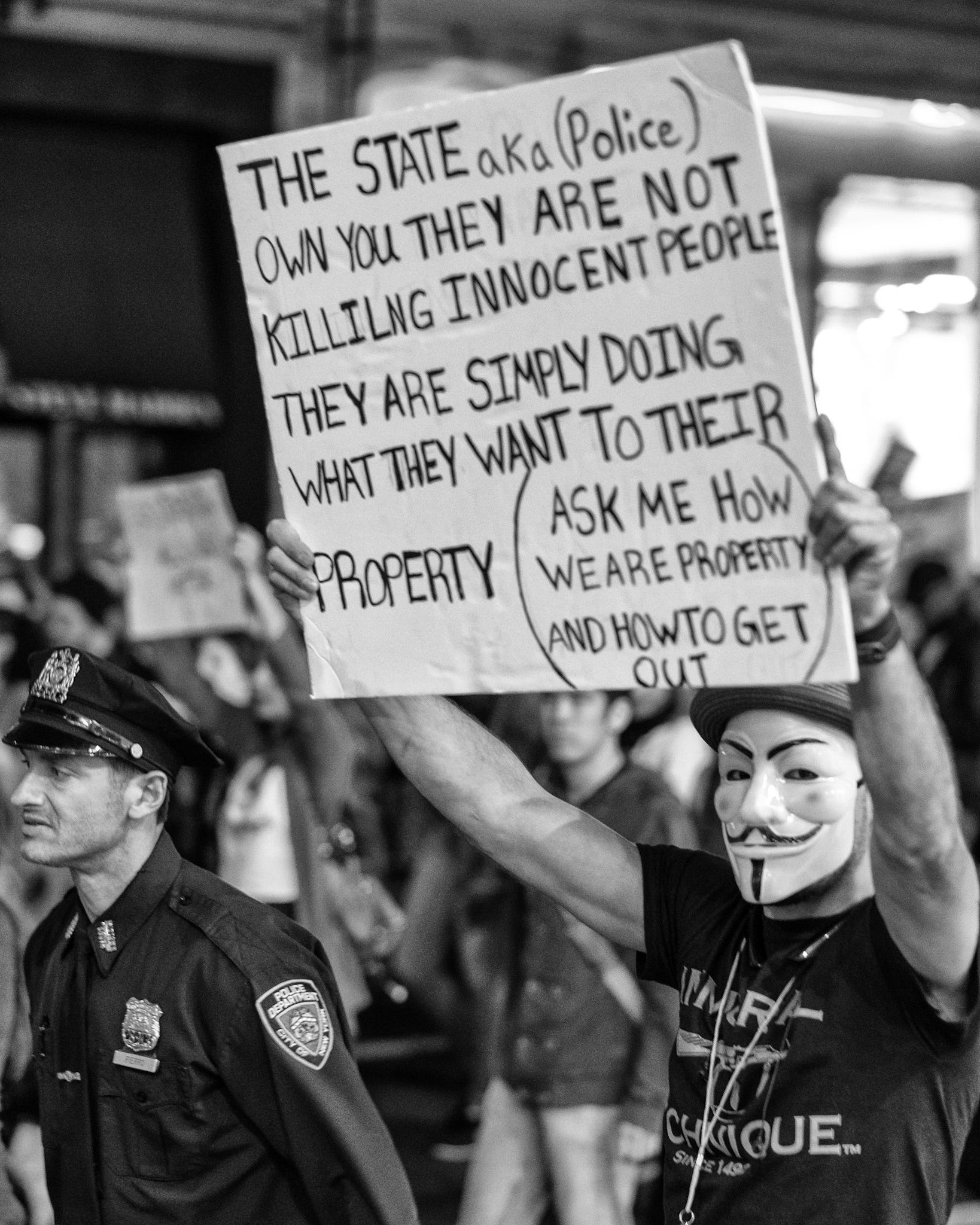
From comic books into the streets, the long arm of Alan Moore stretches on. V for Vendetta, NYC, 2015.
The next time you find yourself getting sucked down the digital rabbit hole, spiraling deeper and deeper into algorithmically curated insanity, ask yourself: cui bono? “To whose benefit?”
If it’s not yours, then why are you bothering?
Protect your reality.